
6. Result-based management and performance management
- Contents
PES need to carefully manage their resources and consider the inputs and how they relate to the results achieved. This encourages PES to think critically about their approach to all activities and to consider what works, and why and what is the impact of these activities. It is important for PES to be able to align their thinking around result-based chains so that PES can improve the performance of their services, where needed, and contribute to a well-functioning labour market. In addition, by being aware of PES performance they can demonstrate their value for money and their added value. This is increasingly important within the context of shrinking public funds and limited resources.
This section will explore the basics around effective results-based management before providing some information on performance management and how PES can use data available to produce labour market information and share this with partners.
Box 28. Key partners to work with for around results-based management
To create systems for result-based management and performance management, PES may consider working with the following types of organisations:
- Media
- Ministries, or other regional/local government bodies
- Trade unions
- Employer representative organisations
- Chambers of commerce
- Media
6.1 What is results-based management?
Results-based management allows PES to look at the inputs, outputs and outcomes of a specific activity and to see what actions are contributing towards the desired outcome, and thus helping the PES to ‘perform.’ This type of approach can provide information to senior managers on the use of resources, where efficiencies and improvements can be made to business processes. This covers all types of resources – human resources, IT and financial resources. The results of such activities can be used by governments to look at overall performance, evidence-based policy making and public sector reforms.
Box 29. Results-based management: a definition1
Results-based management, also known as performance management, has been defined by the ILO as concerning the production of information on performance:
“It focuses on defining objectives, developing indicators, and collecting and analysing data on results. The based purpose of a results-based management system is to generate and use performance information for organisational learning and decision-making purposes.”
Results-based management has seven stages, as outlined in the figure below.
Figure 6.1 Results-based management stages2
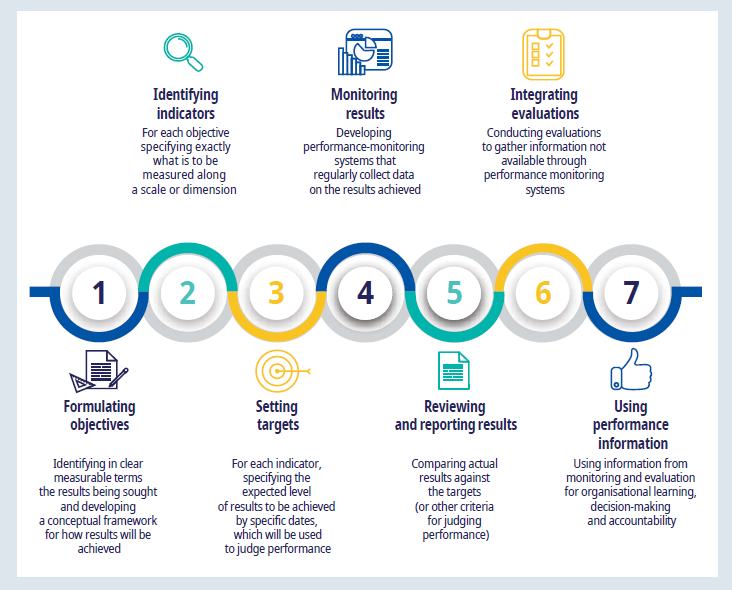
The figure above demonstrates that data collection, and defining what data is to be collected and why, is an important activity for results-based management as this provides a basis for many steps outlined above. Defining what data to collect and what aspects of PES performance are to be measured should be discussed and agreed at senior management level within a PES and the same approach should be taken across PES offices in a regional or national context to allow for comparability. Importantly, collating data will help to demonstrate the achievement of key performance indicators (this is refl ected further in Section 6.3).
When defining objectives, it is important for them to be clear, concise and consistent. A useful acronym is SMART:3
Specific – identifying a specific area for the objective;
Measurable – the objective can be measured;
Assignable – a person can be identified to take forward this objective;
Realistic – the objective measures realistic and relevant content;
Time-specific – identifying a specific time frame for when the objective will be measured.
It is important to note that good IT and data support systems are important for the collection of data. A suitable IT infrastructure for collecting key performance indicators can include:
- A data storage platform
- Analytics application to create metrics
- Dashboard, or other applications to display key performance indicators
- Access created for those who need it.4
Such systems can take some resources to establish but they can pay dividends in the longer term as it is easier to see how the PES is performing, and which areas need further attention.
Box 30. Sustainable Development Goals – key labour market indicators for youth – what they are and sources of further information5
The Sustainable Development Goals (SDGs) continue the work undertaken under the Millennium Development Goals, working towards inclusive, decent work for all ensuring that no one is left behind. They refer to the quantity and quality of employment and other issues.
Goal 8 ‘Promote inclusive and sustainable economic growth, employment and decent work for all’ includes a specific focus on young people not in education, employment or training (also known as the ‘youth NEET rate’). It defines young people as those aged between 15 to 24 (inclusive).
This indicator shows the number of young people not in education, employment or training as a percentage of the total population of young people. It helps to indicate the potential young people who could enter the labour market and it is a measure of the lost potential of human resources.National labour force surveys can be used as a source to calculate the indicator. The calculation should be complemented with information that allows policy makers to see if the problem is with young NEETs not being able to find suitable employment, or if the problem is that they remain outside of the labour force.
Box 31. Results-based management: selected terminology6
This box provides an overview of common terms and their definitions used by the ILO in the context of monitoring and evaluation work. These can also be applied to PES activities in relation to results-based management.
Activity: Actions in the context of programmes through which inputs (financial, human, technical and material) are mobilised to produce specific outputs and contribute to intended outcomes.
Baseline: Data that describe the situation at the starting point for measuring the performance of a programme or project. A baseline study would be the analysis describing the situation prior to the start of development cooperation. The baseline is an important reference point for measuring the results achieved with development cooperation.
Goal: A broad statement of a desired, usually longer-term, outcome of a program/intervention.
Goals express general program/intervention intentions and help to guide the development of a programme/intervention. Each goal has a set of related, specific objectives that, if met, will collectively permit the achievement of the stated goal.Impact: The overall and long-term effect of an intervention. Impact is the longer-term or ultimate result attributable to a development intervention – in contrast to output and outcome, which refl ect more immediate results. Examples: higher standard of living, increased food security, increased earnings from employment, increased savings, reduced incidence of workplace accidents due to improved standards and/or enforcement of standards, etc.
Indicator: A quantitative or qualitative variable that provides a valid, reliable and simple way to measure achievement, assess performance, or refl ect changes connected to an intervention.
Inputs: Resources applied to and utilised in the production of outputs in a project or programme. Such resources include funds, personnel and physical items used in implementation.
Outcome: Actual or intended changes in development conditions that an intervention(s) seeks to achieve through the production and utilization of multiple outputs. The contribution of several partners may be required to achieve an outcome. Outcomes are shorter term and less far reaching, and lower on the hierarchy of results than impact.
Output: Tangible product (including services) of an intervention that is directly attributable to the initiative. Outputs relate to the completion of activities and are the type of results over which managers have most infl uence. An example of an output for a project for trade union management may be the number of trade union leaders trained. Multiple outputs are usually required for the achievement of development outcomes or development impact.
Result: A broad term used to refer to the achievements of a programme or project and/or activities. The terms “outputs”, “outcomes” and “impact” describe more precisely results at different levels of hierarchy.
Target: The objective a programme/intervention is working towards, expressed as a measurable value; the desired value for an indicator at a particular point of time.
Theory of Change: A comprehensive description and illustration of how and why a desired change is expected to happen in a particular context. It is focused in particular on mapping out or “filling in” between what a programme or change initiative does (its activities or interventions) and how these lead to desired goals and development changes. It does this by first identifying the desired long-term goals and then works back from these to identify all the conditions (outcomes, outputs) that must be in place (and how these related to one another causally) for the goals to be achieved. Theories of change are generally developed in reverse from the highest level of programme hierarchy, or development goals and impact through outcomes and outputs to the activities and inputs that are required to achieve them.6.2 What are results-based chains?
Results-based chains are a valuable starting point for PES to move towards results-based management approaches. They involve looking carefully at inputs, outputs and outcomes involved in a process and they can help PES to think about the differences that their activities have and the potential impact of their activities and processes internally (i.e., on PES staff, financial resources and IT resources) as well as externally (on other organisations, jobseekers and enterprises). This can be an initial starting point to look at the labour market outcomes for individuals and thus help to establish what effect the PES has on the overall efficiency of the labour market.
Box 32. Results-based chain frameworks: ILO definition7 and terminology8
The ILO defines results-based chain framework as:
“The results chain sets out the programme logic that explains how the final objectives are to be achieved. It shows the links from inputs to activities, to outputs and to outcomes, to understand how the changes brought about by the programme affect the well-being of individuals.”
When formulating results-based chains, it is important to be consistent and to use the same terminology throughout. There are some of the most important terminology to be aware of when developing results-based chains:
Development objective: this is the long-term change to which the project aims to contribute. It is linked to the national context. It is the stakeholders’ responsibility, and a result to which the project will make a significant contribution, but one that they cannot achieve on their own. The development objective may not be realisable within the project period and may be dependent on the results of other projects and interventions.
Immediate objective or outcome: this is the specific change that the project is expected to bring about by the end of the project – in the quality and quantity of the services provided by the target group, and/or the way in which they are delivered by the direct recipients. The changes defined in the immediate objective are the changes in the:
- Target groups, such as capacities, quality of existing or new services, etc.
- Context in which the target groups operate, such as policy, legislation, information, etc.
- Outputs which the project directly produces, such as training, legislative proposals, policy documents, methodologies, information, awareness raising, intervention models, etc. An output is a product or service that the project delivers to a direct recipient in order to achieve the outcomes. They are the necessary and sufficient means to achieve the outcomes.
- Activities: these are the necessary and sufficient actions to produce the outputs.
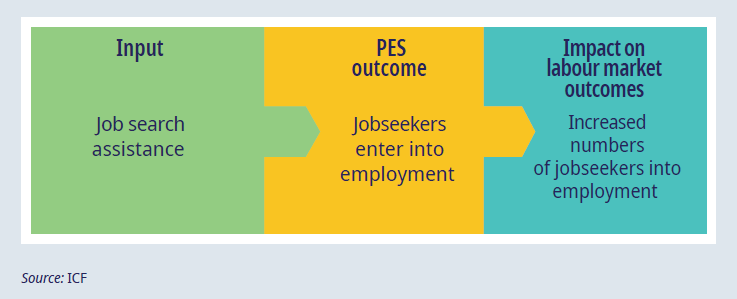
The figure below outlines an example of a basic results-based chain for PES for the activity of providing job search assistance – note that this would cover all aspects of job search assistance from counselling sessions to online information that could be accessed by an individual without close support from the PES.
The example demonstrates how the results-based chain approach can encourage PES to think about specific inputs into a process, what the potential outcomes will be for PES (and in this case, jobseekers) and what the potential impact will be on labour market outcomes (in this case, increased numbers of jobseekers into employment).
Figure 6.2 Example of PES results-based chain
6.3 What are key performance indicators?
Key performance indicators can be a useful tool to start to develop and implement once PES have established and worked with results-based chains for some time. Key performance indicators help PES to make an extra step away from looking at inputs, outputs and outcomes. In addition, they can encourage PES to move away from undertaking routine monitoring activities to looking more strategically at what they are doing, and why, and the general direction of progress.
Box 33. Key performance indicators: a definition9
The European Network of Public Employment Services defines key performance indicators (KPIs) as those performance indicators of the progress towards meeting the highest-level organisational goals and the critical success factors contributing to these goals. Within the context of PES, KPIs are those indicators that are most crucial when understanding whether the PES is achieving its goals.
Key performance indicators are different to monitoring indicators as they look at the higher-level performance and monitoring activities collect information on an ongoing process to look at performance against results. Whereas, key performance indicators is the process of setting high-level indicators that determine what performance means to an organisation, for example what performance levels do the PES view as being the most important when they are considering if the PES is contributing to an effective and well-functioning labour market?
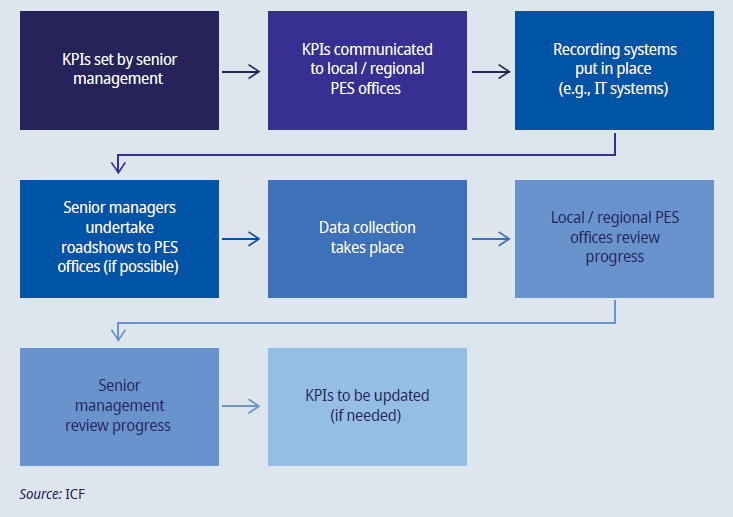
Key performance indicators are usually set by senior management in either the regional head officeor the national head office (depending on the governance arrangements in place). The key performance indicators are then communicated to local, and/or regional PES offices, so that they have awareness, and ultimately ‘buy-in’, of what these are and what ‘good performance’ means to a specific PES. In some European countries, senior managers from national offices have previously undertaken ‘roadshows’ to present their views and approaches to local/regional PES offices so that they can communicate this personally and they can answer any questions from staff on-the-spot. This can be a useful approach if and where key performance indicators are being introduced for the first time or if existing approaches are being changed.
Across the Commonwealth of Independent States (CIS) region, some PES have already started to collect data to support the review of key performance indicators and these look at both process-driven indicators as well as results-based indicators. By separating out process and results-based indicators, PES can collect information for individuals, services and programmes as well as measuring the quality of service delivery.
The table below provides some examples of process and results-based performance indicators that could be introduced by PES in the region.
Table 6.1 Key performance indicators
Performance indicator Disaggregation and calculation method Process Number of registered unemployed receiving employment services Number of participants in a period over total number of registered unemployed Individuals: age, sex, level of education, prior work experience, benefit receipt, disability, unemployment spell, other disadvantage Service: information, counselling, vocational guidance, individual employment planning, job mediation, job fairs Number of registered unemployed participating
to active labour market programmesNumber of participants in period over total number of registered unemployed Individuals: as above
Programme: labour market training, recruitment subsidy, self-employment schemes, public worksCoverage of the target population Number of participants to services and programmes over total target population Individuals: as above
Service/programme: as aboveAverage cost per participant Total cost of service/programme over total number of participants
Service/programme: as aboveResults Employment rate (gross) Total number of participants who are employed six months after the end of the programme over the total number of participants
Individuals: as above
Service/programme: as above
Employment: type (wage employment, self-employment), contract-duration, occupation, average earnings, skills matching, social protection entitlements, usefulness of service/programmeAverage cost per placement Total cost of service/programme over total number of participants employed
Service/programme: as abovePercentage of job vacancies filled Total number of vacancies filled over total number of vacancies notified
Vacancy: occupation, type and size of enterprise, economic sectorILO (2013) ‘Monitoring and evaluation of youth employment programmes: A learning package’.
This is not an exhaustive list, but it provides some examples of performance indicators that can be used by PES.
There are different methodologies to using key performance indicators within a wider performance management approach. PES across Europe use a variety of approaches that cover:
- Including measures of satisfaction and services among jobseekers and enterprises;
- Data presentation systems, such as balanced scorecards (see the case study below); and
- Analysis of management information and overall labour market information.
Case Study 20. Balanced scorecards: a definition and application in Austria10
A Balanced scorecard (BSC) is a performance management tool that objectively compares PES organisational units against each other based on the key objectives of the PES’ mission statement.
The BSC is weighted to take account of key resource dimensions, including staffing and budgets, and different local situations. It helps to define targets and focal points for development for the local PES offices and, on a wider level, it helps to implement the PES organisation’s overall mission strategy.The Austrian PES has used the BSC approach since 2015. Since its introduction, the performance has significantly improved for almost all local PES offices, along with the performance average of local offices. The gap between the best and worst performing PES offices has also reduced. The indicators that have seen most improvement are customer satisfaction and reaching labour market goals.
When developing and introducing key performance indicators and a performance management system, PES may want to consider the following pointers11 that can contribute to smooth implementation:
- Piloting and pro-typing: PES could consider using a small-scale pilot, or prototype, before it is rolled out on a larger scale. This can be a useful process to gather feedback and make any necessary improvements before any systems, or tools, are rolled out further.
- Staged roll out: This means that a system and tools can be rolled out slowly and across one, or several, PES offices or areas at specific time points before it is rolled out on a full basis. This can be useful if it is a large-scale change as it allows more time for communication with PES staff and for any changes to be made.
- Dashboards can be developed on different levels (if, and where, they are used): They can be adapted to each users’ needs so that information is tailored to different audiences, but they still retain an element of transparency.
Figure 6.3 Workflow for Key Performance Indicators (KPIs)
The ILO has outlined some common mistakes to avoid when developing indicators. These include:
- Not measuring the change you want to see: Take time to make sure that output indicators measure outputs, and outcome indicators measure outcomes and that indicators measure a target group that is the same in which you expect change to occur.
- Not thinking about slow change, and fast change: The size of change can affect the reliability of statistical indicators at outcome level. Indicators need to be carefully selected and considered whether rolling averages need to be provided to avoid potential spikes in performance.
- Not realising indicators are part of a package: To be able to measure performance, indicators must come with baselines, milestones and targets as these describe the starting point and the desired end point.
These common pitfalls are important to factor in when looking at client satisfaction (sometimes known as customer satisfaction) can be incorporated into performance management systems and it can be something to consider when considering and developing key performance indicators. The box below provides a short summary of what client satisfaction is, how their levels of satisfaction can be measured and how the results can be used to drive forward performance.
Case Study 21. Introduction to client satisfaction
Client satisfaction activities in PES find out how their clients, primarily jobseekers and enterprises, value PES services. It is important to collect this information and measure their satisfaction as it can help to continuously improve PES services, particularly in terms of ensuring that these services are more closely linked to customer needs.12 As PES collect information and insights from clients on a regular basis, it provides information as a basis for regular improvements to services and this may help to improve the efficiency of PES services. In addition, by conducting client satisfaction activities it can create a sense of transparency and public accountability of PES.
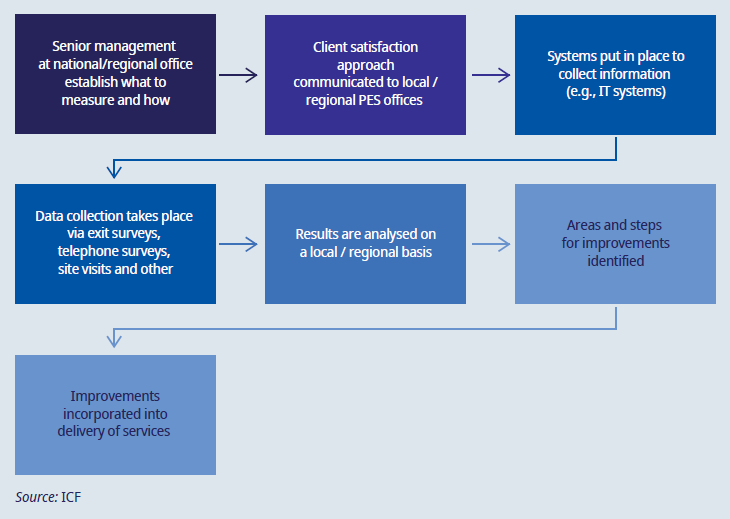
PES can use a range of different methods to collect client satisfaction ranging from surveys (by phone, mail, Internet or in person (e.g., exit surveys after a PES visit) to face-to-face interactions such as interviews, focus groups, customer journeys (more information below), to site visits in the case of enterprises.13
Outcomes of client satisfaction activities can be reviewed and analysed with a view of identifying poor performing areas or services, and any suggested steps for improvement.
Figure 6.4 Workflow for client satisfaction from design to results
6.4 How can PES collate and promote labour market information?
PES have a unique position in the labour market as they have access to in-depth information about the current state of the labour market, future trends and can offer interesting insights on what the implications of these trends can be on enterprises, jobseekers, ministries and wider society. By having systems in place for monitoring the labour market, PES can create data sets that tell the story about the economy which can be of value to other organisations, such as partners and the media. Sharing such knowledge and insights can therefore reinforce the knowledge of PES and their added value.
PES can package labour market information together and provide this to stakeholders as a PES service.Different stakeholders such as other ministries, trade associations, chambers of commerce and local/regional governments are often interested in the state of the labour market and as PES have access to such data they are in a unique position to provide this to partners. PES can also use the data to identify key messages, trends and implications for wider society or a specific group, tailored to the needs and interests of the recipients. Such activities can be part of a PES’ wider strategic communication activities and can be factored into any planning around communications. By showing in-depth knowledge and expertise in the labour market, this can reinforce and strengthen PES’ position in the labour market and demonstrate their added value.
The figure below outlines the process of collating and sharing labour market information and, as a result, demonstrates PES’ knowledge and expertise.
Figure 6.5 Process of collating and sharing information to demonstrate PES’ knowledge
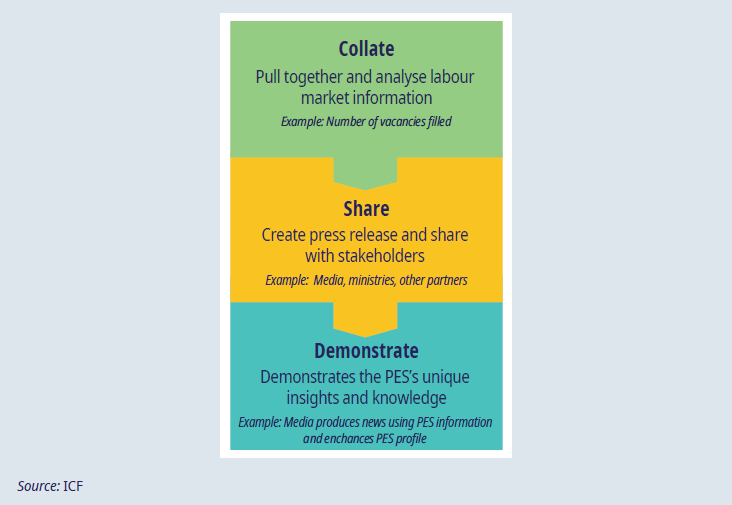
Across Europe some PES collect labour market information on a monthly basis and share this information with the media.14 This includes the number of registered unemployed people, number of vacancies filled, number of open vacancies and the job growth. This has helped to create a positive impression of PES as they are viewed as the go-to institution for facts and statistics about the current state of the labour market. However, creating a positive view of PES has taken time.
Labour market information is also important for other partners who want to view the skills and sectors that are in demand and highlight where there are skills gaps. This can be useful to education providers, education ministries, chambers of commerce and trade associations and others who may be involved in the development and design of qualifications, particularly those involving work-based learning.
Box 34. Importance of using LMI in skills anticipation and matching for the development of apprenticeships and work-based learning1516
Labour market information can help stakeholders to identify current and future skills needs as this information can identify current and future gaps in the types of jobs that have vacancies and the skills that jobseekers have. Such information can be used to make decisions and develop activities that help to re-address the imbalance. This can help to bridge the gap between education and the labour market and make sure that those (re-)entering the labour market have appropriate opportunities to help them to upskill or reskill, in line with the needs of the labour market.
Partnership working is important for this to be successful. Participating in social dialogue can aid the dissemination of information and insights that PES have on the labour market. As a result, partners can make informed decisions about the provision of skills training.
The case study below demonstrates how the PES in Kyrgyzstan work with other partners to use labour market information to forecast skills needs and to guide low-level jobseekers into their next steps towards sustainable employment.
Case Study 22. Kyrgyzstan – developing and using a ‘demand map’ to demonstrate the labour market needs*
Labour market institutions in Kyrgyzstan have worked together with enterprises and workers organisations to develop a ‘demand map’, to forecast the demand for skills in the country. The demand map is used by PES to provide relevant, practical vocational guidance and training to jobseekers who have a low skill level, or outdated skill sets, and want to improve their skills.
Education providers also use the demand map to adjust curricula so that it best fits the needs of enterprises. The demand map has been a useful tool as 70% of people who have been directed to training, in line with the demand map, have found employment after completing their training.
Box 35. Results-based management:
Below is a checklist of the key features that should be included in a good quality approach to developing results-based management approaches:
- A set of organisational outcomes, and strategic objectives, which are supported by SMART Key Performance Indicators (KPIs)
- A system for collating, analysing, and promoting labour market information (LMI)
- Workfl ow data (on activities/processes) can be recorded to enable performance measurement
- IT systems record staff actions for input to performance measurement system
- A system to report on and review results, and communicate these to staff, customers, and external stakeholders
- A mechanism established for using performance information for monitoring, evaluation, assisting service improvement, and ensuring accountability
- Required HR and legal permissions to operate KPI system secured
- Defined and costed Inputs, Outputs and Outcomes
- Disaggregated definitions enabling client characteristics to be recorded, i.e. age, gender, level of education, prior work experience, receipt of unemployment benefit/social assistance
- PES services described by function, e.g. counselling, vocational guidance, individual employment planning, job mediation, job fairs
- Status of Employment recorded by type (wage employment, self-employment), contract duration, occupation, average earnings, skills matching, social protection entitlements
- Vacancies classified by occupation, type and size of employers, economic sector, occupational group, type and level of qualifications required
- Guidance for staff on operation of KPI system
Box 36. Questions for self-reflection
Use the questions below to think about the steps your PES need to take to develop and implement to develop results-based management approaches.
- To what extent do KPIs support PES strategy, achievement of objectives, and delivery of labour market policies? Can the KPIs be redefined to better achieve this?
- What use is currently made of labour market information? How can more benefits be obtained from further exploiting this?
- What further use can be made from analysing performance management information including enhanced monitor and evaluation of PES service delivery?
- Does performance data provide sufficient information on services for particular priority customer groups, if not how can this be achieved?
- ^ ILO (2013) ‘Monitoring and evaluation of youth employment programmes. A learning package’ (https://www.ilo.org/wcmsp5/groups/public/-ed_emp/-emp_policy/documents/instructionalmaterial/wcms_384468.pdf)
- ^ Ibid.
- ^ European Commission (2019) ‘Getting started with key performance indicators’ (https://ec.europa.eu/social/BlobServlet?docId=20673&langId=en)
- ^ Ibid.
- ^ ILO (2018) ‘Decent Work and the Sus tainable Development Goals A Guidebook on SDG Labour Market Indicators ‘ (https://www.ilo.org/ilostat-files/Documents/Guidebook-SDG-En.pdf)
- ^ ILO (2016) ‘ILO Decent Work Country Programme: A practical guidebook’ (https://www.ilo.org/wcmsp5/groups/public/-ed_mas/-program/documents/genericdocument/wcms_561025.pdf)
- ^ ILO (2013) ‘Monitoring and evaluation of youth employment programmes: A learning guide’ (https://www.ilo.org/wcmsp5/groups/public/-ed_emp/-emp_policy/documents/instructionalmaterial/wcms_384468.pdf)
- ^ ILO (2018) ‘Development Cooperation Internal Governance Manual’ (https://www.ilo.org/wcmsp5/groups/public/-dgreports/-exrel/documents/publication/wcms_452076.pdf)
- ^ European Commission (2019) ‘Getting s tarted with key performance indicators’ (https://ec.europa.eu/social/BlobServlet?docId=20673&langId=en)
- ^ European Commission (2016) ‘AMS – Balanced Scorecard’ (https://ec.europa.eu/social/BlobServlet?docId=15215&langId=en)
- ^ European Commission (2019) ‘Getting s tarted with key performance indicators’ (https://ec.europa.eu/social/BlobServlet?docId=20673&langId=en)
- ^ European Commission (2016) ‘Practitioners’ toolkit to assis t PES with the development of cus tomer satisfaction measurement sys tems’ (https://ec.europa.eu/social/BlobServlet?docId=15855&langId=en)
- ^ European Commission (2018) ‘Methods of quality management’ (https://ec.europa.eu/social/BlobServlet?docId=20389&langId=en)
- ^ European Commission (2017) ‘Making the PES business case’ (https://ec.europa.eu/social/BlobServlet?docId=17482&langId=en)
- ^ ILO (2017) ‘ILO Toolkit for Quality Apprenticeships Volume 1: Guide for Policy Makers’ (https://www.ilo.org/wcmsp5/groups/public/-ed_emp/-ifp_skills/documents/publication/wcms_607466.pdf)
- ^ ETF, Cedefop and ILO (2016) ‘Using Labour Market Information: Guide to anticipating and matching skills and jobs’ (https://www.ilo.org/wcmsp5/groups/public/-ed_emp/-ifp_skills/documents/publication/wcms_534314.pdf)