
7. Strategic partnerships to create the conditions for sustainable employment
- 7.1 What are tripartism and social dialogue and how can they contribute to partnership working?
- 7.2 How can governance structures support the implementation of local partnerships for employment?
- 7.2.1 What steps and tools can PES use to make sure that they have the right governance in place?
- 7.2.2 How can PES demonstrate the contribution of employment services to achieving employment policies?
- 7.2.3 What can PES contribute to employment policies according to their core institutional mandates?
- 7.3 How can PES participate in strategic partnerships to create integrated services to disadvantaged groups and increase coherence between employment and social policies?
- 7.4. What is the role of partnerships for reducing skill mismatches and fostering cooperation between education and the world of work?
Strategic partnerships mean working with other organisations who have an interest in PES activities (i.e., stakeholders) to develop and shape strategic decision making and the future direction of PES services.
Through the involvement, adequate consultation and participation of stakeholders, partnerships develop cross-cutting perspectives and integrated approaches to multidimensional problems.2
Working with stakeholders in the short term can provide opportunities for others to provide quick feedback on specific activities, open up access to other networks and specific target groups and PES can also ‘piggyback’ on others’ communication activities to spread the word about PES activities and services. Longer-term, strategic partnerships can create the foundations for embedding closer relationships between PES and other stakeholders and, over time, help to change any negative perceptions of the PES.
In addition, strategic partnership working can be multi-layered from local to policy level to enhance PES delivery, as well as policy planning.3 By working in strategic partnerships, PES can develop more wellinformed policies and measures and deliver services more effectively, thus contributing to better labour market conditions.
Box 37. PES stakeholders: who are they?
There are lots of different stakeholders for PES and many of these are suitable for PES to work together with in a strategic partnership arrangement. Some organisations have been noted below as a starting point. The precise list of stakeholders and potential partners for each PES depends on their local, regional or national context.
- Education and training providers (including schools)
- Organisations representing specific groups of jobseekers, e.g. disability-rights organisations, youth organisations
- Employer and business membership organisations (EMBOs), or other industry-based membership bodies
- Chambers of Commerce
- NGOs
- Municipalities, or other local/regional/national government bodies
- Other relevant public services/departments, e.g. social services
- Private employment agencies (PrEA) services
- Local/regional or national media (online, broadcast and print) – note, this should focus on promoting the results and outcomes of services and share information on the state of the labour market
PES offer unique insights and knowledge about the labour market and the challenges that are faced by jobseekers and enterprises, as well as having access to labour market information. This is information that other stakeholders may not have access to and therefore PES can use this within the strategic partnerships to overcome any negative perceptions that other stakeholders may have around PES. This is important for PES to consider when establishing working relationships with other organisations as this can contribute to creating a ‘win-win’ situation for the different actors involved.
PES need to consider the level of activity or scope of discussions as this will determine the reach and scale of the intended partnership. PES should think if the activity is better framed within a local, regional or national perspective and then consider which stakeholders would be best suited for the topic. If it is national (or regional, in cases where PES are decentralised) topic, then there may be local perspectives that still need to be addressed and in this case the PES could consider if any stakeholders will have a national head office and local/regional offices whom local/regional PES offices could ‘partner’ with. This will help to ensure that the conversations at each level are appropriate, fruitful and are of benefit to all parties.
It is also worth highlighting that the media can be used by PES to promote positive results and new programmes. The media can therefore be an important partner in terms of reaching out to (potential)
jobseekers, enterprises and developing a wider awareness in the general public of PES and PES services.
By providing the media with labour market information and creating key messages around this, PES can demonstrate to the media that they are the labour market experts.
7.1 What are tripartism and social dialogue and how can they contribute to partnership working?
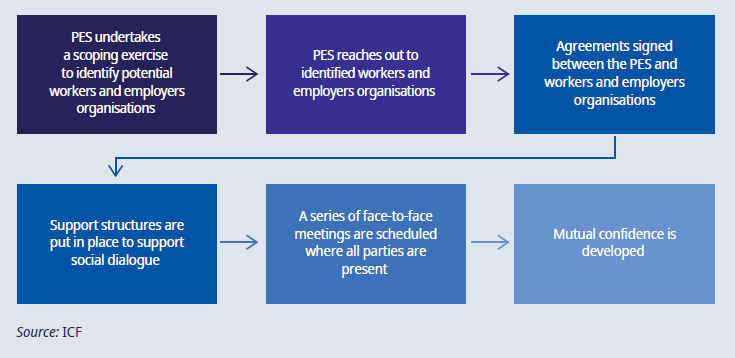
Tripartism and social dialogue are important concepts in strategic partnerships, and they are the foundations for respectful, equal and high-quality partnership working. The box below provides the ILO definitions of tripartism and social dialogue. The key principles include building consensus, equality of all views, respect and commitment from participants. To be successful, both tripartism and social dialogue focus heavily on processes around exchanging information, communication and negotiation (where needed). By developing strategic partnerships around these important principles, it is likely that PES will be able to gather more in-depth insights from other organisations at important decision-making moments and throughout the development, design and delivery of important policies as well as on-the-ground activities. This will increase the likelihood of PES delivering efficient and effective services that meet real needs on the ground.
Box 38. Definition of social dialogue and tripartism4
The ILO’s guide to tripartite social dialogue states that social dialogue includes “all types of negotiation, consultation or information sharing among representatives of governments, employers and workers or between those of employers and workers on issues of common interest relating to economic and social policy.”
Tripartism is a form of social dialogue. The ILO defines tripartism as “the interaction of government, enterprises and workers (via representatives) as equal and independent partners to seek solutions to issues of common concern.” All of the different viewpoints and arguments offered by the separate groups are treated as equal.
It is important to remember that there is no ‘one size fits all’ approach to social dialogue as it needs to be adjusted to institutional arrangements, legal frameworks, traditions and practices in a specific context.
The ILO recommends that there are four aspects5 that need to be in place as a precondition to social dialogue being used:
- Strong, independent workers’ and enterprises’ organisations exist and they have the technical capacity and access to relevant information
- Political will and commitment from all parties to engage in social dialogue
- Respect for the fundamental rights of freedom of association and collective bargaining
- Enabling legal and institutional framework.
Figure 7.1 Key steps to apply the ILO social dialogue approach6
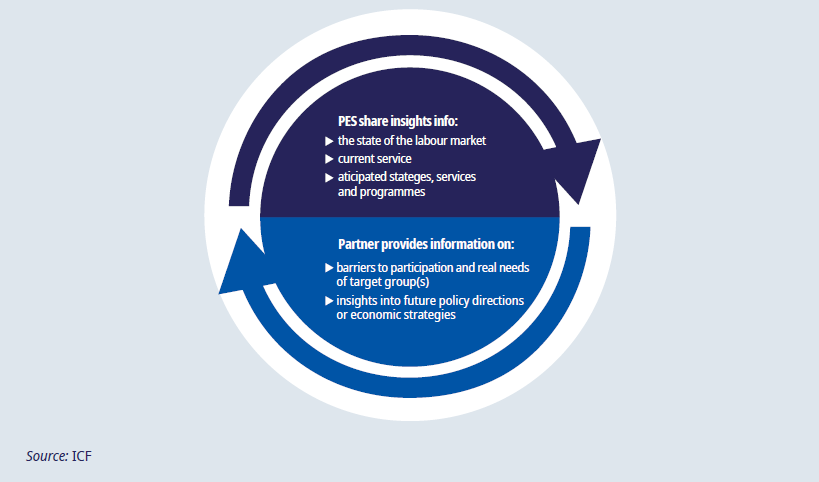
Knowledge sharing is at the heart of social dialogue and tripartism. This is a two-way process where PES can share insights into the labour market, programmes and policies and the insights offered by partners can be wide-ranging. The diagram below shows what PES can offer to partners and what information partners can provide to PES.
Figure 7.2 Sharing knowledge with stakeholders
Dialogue with partners should not be a one-off , tokenistic activity and instead it should be in-built to both the development of any new services and the ongoing planning, delivery and review of current service provision. This ensures that feedback and different views can be regularly captured. There are different mechanisms for this but importantly, this should at least initially include face-to-face contact, which will help to develop personal connections and mutual trust between the PES and partners.
One proven approach to working with partners is having regular quarterly meetings with local, or regional, stakeholders. This can include:
- Presenting information on the local labour market
- Expected trends
- Presentation of new programmes or activities and their results to date (if known)
- Opportunity for others to offer views on PES developments, and results
- Input from others on their developments.
It is advisable that this can be complemented by a written note produced afterwards as well as sharing of information and news from the PES in between meetings. For example, a similar approach is used in the Astrakhan Region in the Russian Federation. This PES has a social council in place that brings together trade unions, the education sector, enterprise representatives and others with the aim to monitor and improve employment conditions. In addition, in Armenia, a ‘tripartite commission’ has been established which brings together enterprises, employment centres and trade unions on a regular basis to share information and make common agreements.
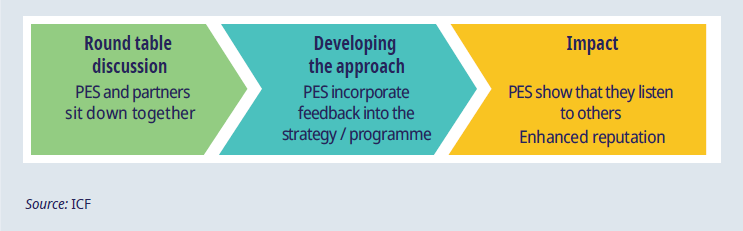
When PES are developing new strategies or programmes a round table discussion can include other partners with specific expertise and interest relevant to the new proposal. These partners can be invited with a clear remit to provide constructive feedback on the idea in focus. A round table discussion can include:
Presentation from the PES on the new idea, and the reasons behind it,
- Opportunity for each participant to provide feedback on the strengths of the idea – what do they like?
- Opportunity for each participant to identify what they think needs to be improved – what changes would they like to see, and why?
PES can use the feedback when developing the strategy, or programme. The figure below outlines this process and what the impact can be on partnership working. This type of approach is successfully used in the Russian Federation by the Republic of Bashkortostan in developing a strategic programme (see the Case Study below).
Figure 7.3 Using round table discussions to develop approaches
Case Study 23. Using tripartism to develop strategic programmes: the example ofRepublic of Bashkortostan, Russian Federation and ‘Decent Work in the Republic of Bashkortostan’7
The Republic of Bashkortostan, in the Russian Federation, was the first region in the country to design and adopt a tripartite format to develop and design the ‘Decent Work in the Republic of Bashkortostan’ programme. Tripartism helped the PES to work with other parties to define task and responsibilities for its implementation until 2025. Tripartite and bipartite social dialogue at all levels aims to improve employment conditions and defend workers’ rights.
7.2 How can governance structures support the implementation of local partnerships for employment?
PES governance arrangements can strengthen, or inhibit, PES’ ability to work with local partners. Governance arrangements can provide more fl exibility at local levels (e.g., decentralised arrangements),
with more responsibilities placed with local or regional offices to form their own approaches, partnerships and other such matters. In contrast, centralised governance arrangements mean that all decisions are taking at a central office, most often on a national level. In terms of partnerships, this can mean that decisions to work with others are made at this central office and they advise, or inform, local and regional offices who to work with. This can place certain ‘restrictions’ on local offices on whom they could work with. Ultimately, governance systems should be in place to create supportive conditions for meaningful local partnerships to be established and mechanisms for ongoing communication and exchange between PES and local partners.
Across the world, most PES work with local partners, but the types of partnerships/working arrangements and the ability to cooperate often differs across, and within, national boundaries due to:8
- Issues with PES capacity (e.g., PES ability to have staff in local areas and their ability to work with local partners to collect timely and relevant data);
- Differences in local fl exibility across regions, and by management approaches (e.g., local offices having more autonomy versus a ‘centralised’ system);
- Level of decentralisation of the PES, i.e. how much power and freedom a local PES office has to decide who they want to work with, when and why; and
- Different ‘top down’ and ‘bottom up’ initiatives that are in place to encourage collaboration, such as policy initiatives to bring different partners together or the establishment of local task forces to tackle unemployment in one specific city/local area.
Governance systems can also provide strategic frameworks for the context of partnerships. At local and regional level, strategic frameworks can provide the ‘structure’ for working with local partners and indicate the benefits of such work, including:
- Gathering insights at local level on policy and programme intervention on what does and does not work;
- Becoming aware of issues that may cause labour market exclusion, particularly local factors, and being able to efficiently plan use of resources so that partners and services can work together;
- Developing and identifying shared objectives and priorities, creating common visions and integrated strategies; and
- Strengthening the ability for PES and partners to develop innovative solutions that are adapted to local situations.
7.2.1 What steps and tools can PES use to make sure that they have the right governance in place?
Strategic fl exibility can help PES to develop and achieve operational excellence within local contexts. The OECD defines strategic fl exibility as the ‘ability of PES actors working at the local level to develop strategies and customise policies and programmes that respond specifically to local labour market conditions.’
The table below outlines key aspects that are useful to have in place when developing PES local governance.
Table 7.1 Key aspects for PES local governance
| Area | Key questions to consider |
| Designing policies and programmes |
|
| Budget allocation |
|
| Eligibility and target criteria | Can local PES offices decide on their target groups for their programmes, or are these set centrally? |
| Performance management |
|
| Managing networks of local development policies/collaboration |
|
| Outsourcing |
|
Source: IDB; WAPES and OECD (2015) ‘The World of Public Employment Services: Challenges, capacity and outlook for public employment services in the new world of work’
The OECD has also outlined a set of different tools that can be used by national governments, and can be applied by PES, to promote and increase a culture of fl exibility:9
- Negotiating targets – consulting at the local level when setting government targets
- Increasing the use of outcome targets, rather than output targets;
- Establishing common and cross-sector targets which incentivise local actors to work together;
- Boards and scrutiny panels which allow a wider group of local actors to scrutinise delivery of national programmes;
- Flexible funding schemes and special funds to encourage creative solutions at the local level; and
- Incremental responsibility – devolving decision making where accountability risk is judged to be minimal.
As well as tools to foster the conditions for the right governance, PES also need to ensure that they have appropriately skilled staff in place to ensure that they can work successfully with strategic partners. The next section provides an introduction to the key requirements around staff resources in this area.
7.2.1.1 What staff resources are needed to work with strategic partners?
Internally, PES need to have the right staff resources available to ensure that they can create conditions conductive to strategic partnership working. When working with stakeholders through strategic partnerships PES need to be able to respond to partners quickly and using clear communication. This is important to demonstrate PES’ expertise, capacities to work with other partners and provide them with the time to build relationships with other stakeholders. Larger PES may have the resources and access to a dedicated external relations team. Smaller regional or local PES may have a small group, or a lone individual, who can undertake the role of ‘partnership manager’.
The individual, or team, undertaking the role as partnership manager needs to have excellent interpersonal skills, be client-oriented and be able to network internally within the PES as well as with different external stakeholders, upholding the key principles of social dialogue and tripartism. For internal communications, they will need to work closely with respective units where and when required but also maintain an excellent knowledge of different PES activities and individual units as well as the wider labour market. This is important as they are the key contact for stakeholders and therefore their attitudes, behaviours and overall professionalism will refl ect the working practices and attitudes of the PES as a whole.
It is therefore vital that the partnership manager(s) receives appropriate training and support to develop their skills in terms of communications as well as ensuring that they keep up-to-date with wider PES activities. Partnership managers must therefore be included within all required internal information networks and receive appropriate updates and briefings. This is particularly important as the skillset of partnership managers is slightly different to other professions within the PES. PES need to invest in tailored training programmes so that they can build effective partnerships as this will have long-term benefits to the information and insights available to PES as well as how they are viewed.
7.2.2 How can PES demonstrate the contribution of employment services to achieving employment policies?
PES play a key role in the labour market and undertake valuable work that contributes to achieving national employment policies. The ILO reported in 201811 that across the world many PES have gone beyond the core functionality of job-matching and instead, they now offer much more comprehensive and holistic support to the labour market. For example, many PES have now fully developed services for employers and jobseekers that address skills mismatches and enhance employability. Through designing and delivering active labour market programmes they also can directly support workers and employers.
With such activities, PES can collect data and use this to create a portfolio of evidence to demonstrate how their services have made an impact and contributed to employment policies. The ILO reports that since the economic crisis in 2008 many countries are now expecting evidence-based advice on policies and interventions. Countries are increasingly wanting to know ‘what works, for who and why’ so that they can create more job opportunities for all types of workers. By learning about what works and improving practices, PES can develop more efficient and effective measures and support services for employer and jobseekers, lead
ing to better matching. In the long term, this will help to maximise the potential of the labour market as it can increase employment rates and thus contribute to greater economic activity.
PES are at the forefront of delivering services that put economic and employment policies into action. To help support and shape future employment policies PES have the potential to gather data via their delivery and reporting mechanisms. By collecting and analysing such data, PES can show to a wider group of stakeholders (e.g., government and local/regional partners) the impact of their services, including targeted programme delivery. Communicating results and outcomes may help to boost their profile and enhance their reputation.
Strategic and brand communication can be an important tool to overcome common reputational challenges related to PES, which often include:
- Negative attitudes about governments in general
- Funding limitations
- Different levels of brand recognition
- Different approaches to strategic and communication processes12
PES can enhance their reputation with partners by undertaking tailored strategic and communication activities. Strategic and communication activities follow a five-step process, as outlined in the table below.
Table 7.2 Five-step process for strategic and brand communications
| Step | Process | Central objectives |
| 1 | Identifi cation of needs | Help PES understand its communication needs; stakeholders and the characteristics of stakeholders and PES needs in a complex and diverse environment |
| 2 | Design strategy | To develop measurable objectives and message frameworks in order to translate the needs identifi ed in Step 1 into aligned, actionable and measurable objectives |
| 3 | Create messages | Help PES apply information from Steps 1 and 2 to produce effective, action-orientated messages that appeal to targeted stakeholder groups |
| 4 | Mobilise and monitor | Focus on implementing the communication plan and evaluating its success; identify strategic changes that need to be made and demonstrate return on investment of resources |
| 5 | Evaluate and evolve | Undertake a summative evaluation (see the box below for information), assess the outcomes and results and feedback into future communications activities helps PES to build on their reputation and improve communication outcomes |
European Commission (2018) ‘Communication and (re-)branding toolkit for employment services’
Box 39. Summative evaluation: What is it?
It is the final assessment of campaign’s outcomes, relative to its intended and unintended effects. Its intended effects focus on the assessment of how effectively the campaign was able to meet its measurable objectives based on the thresholds established before the campaign (and potentially adjusted during the communications campaign). Its unintended effects recognise that often campaigns may result in outcomes (both positive and negative) that were not foreseen. Summative evaluation is used as a way for organisations to critically refl ect the campaign in order to determine action-steps and future campaign development.
Ultimately, PES need to be sufficiently funded so that they can deliver high-quality, successful services and also undertake communication activities. The ILO13 recently called for PES to be adequately funded so that they can face the challenges of the labour market, provide effective support with the increasing transitions in the labour market and evolve into a more proactive organisation. An important part of the new approach is levering the potential of local, regional and national partnerships to ensure that PES can work with others to develop approaches that are ‘fit’ for purpose. Such partnerships can also include working with private employment agencies (further information can be found in 7.2.3.1).
7.2.3 What can PES contribute to employment policies according to their core institutional mandates?
Understanding the core institutional mandates for PES is fundamental to understanding the role, responsibilities and objectives that need to be in place. These can then be aligned and tailored accordingly
towards national, or regional, employment policies. Indeed, at the foundation of all PES activities, they contribute to three main national objectives:
- Support labour market inclusion;
- Facilitate labour market adjustments; and
- Mitigate the impact of economic transitions.
Box 40. ILO Employment Service Recommendation, 1948 (No. 83)14
The ILO Employment Service Recommendation of 1948 (No. 83) provides recommendations on the organisation of employment services. Some of the key components outlined include:
- PES need to provide support on labour market inclusion by re-addressing inequalities and employment barriers faced by disadvantaged groups (e.g., assisting with the motivation, employability and job opportunities) and help such groups to enter the labour market.
- PES should facilitate labour market mismatches, for example over-supply, unemployment and skills shortages as well as over/under qualifications and looking at current skills and future labour market skills’ demands.
- PES can use labour market information as a strategic tool to analyse cause and effect of labour market mismatches (i.e., between supply and demand).
- PES have a role in facilitating the mobility of labour. The ILO Recommendation outlines four categories of worker transitions, which include transfer between regions with oversupply of labour to labour shortages; between economic sectors; imbalances between labour and the demand for labour; and international mobility (e.g., migrant workers).
- PES should have a role in mitigating the impact of economic transitions, covering moves between recessions/economic decline and periods of growth; structural transformations into higher productive sectors (i.e., from informal to formal); moving from industrial to digital based economies; local to global labour markets; and carbon-based to green economies.
It also stresses that employment services should collect labour market information on:
- Current and prospective labour market requirements (including the number and type of workers needed, group according to industrial, occupational or geographical basis)
- Current and prospective labour supply (including number, age, sex, skills, occupations, industries, location, applicant characteristics)
Further, it recommends that employment services can undertake continuous or ‘special’ studies on areas that cover:
- Causes and incidence of unemployment, including unemployment related to technological developments;
- Placement of particular groups of applicants for employment such as disabled workers or young people;
- Factors affecting the level and character of employment;
- Vocational guidance in relation to placement;
- Occupational and job analysis; and
- Other aspects regarding the organisation of the labour market.
The ILO Employment Services Recommendation also states that ‘employment services should co-operate with other public and private bodies concerned with employment problems.’ It specifically states that employment services should consult with such bodies around the questions of:
- The distribution of industry;
- Public works and public investment;
- Technological progress in relation to production and employment;
- Migration;
- Housing;
- Provision of social amenities (e.g., schools, health care); and
- General community organisation and planning, which may affect the availability of employment.
The following section provides further information on how PES can work with private employment agencies.
7.2.3.1 What is the difference between public and private employment agencies and how can they best work together to achieve common employment aims?
Public employment services and private employment agencies (PrEA) have some similarities in common but they also have some very important diff erences that need to be considered. Both PES and PrEA provide support to enterprises and jobseekers with regards to the matching process. However, PES are provided by the state where as PrEA are commercial-based organisations which are completely independent of the state. PrEA tend to:
- Offer services to enterprises, for a fee, with an aim to provide a quicker matching process;
- Concentrate on skilled job candidates for enterprises, upon demand; and
- Actively recruit for foreign workers for enterprises in their country or can organise migration for work abroad.15
In many countries, there are specific types of PrEA that offer temporary forms of employment. These temporary work agencies offer their workers for short term employment assignments to enterprises.
These can help to fill specific gaps for enterprises and a fl exible, accessible workforce. The box below provides information on the ILO convention on PrEA.
Box 41. ILO Private Employment Agencies Convention, 1997 (No. 181)16
The convention terms private employment agency means any natural or legal person, independent of the public authorities, which provides one or more of the following labour market services:
(a) services for matching offers and applications for employment, without the private employment agency becoming a party to the employment relationships which may arise therefrom;
(b) services consisting of employing workers with a view to making them available to a third party, who may be a natural or legal person (referred below as a “user enterprise”) which assigns their tasks and supervises the execution of these tasks;
(c) other services related to job seeking, determined by the competent authority after consulting the most representative employers’ and workers’ organisations, such as the provision of information that do not set out to match specific offers and applications for employment.
It is worth noting that in some countries the protective provisions established in law may not cover certain types of workers who are recruited via PrEA and in many countries only jobseekers registered with the PES are eligible to participate in ALMPs.
PES and PrEA are not competitive, instead cooperation between PES and PrEA can be mutually beneficial. Cooperation can provide opportunities to:
- Share information;
- Cooperate on job matching services that are provided to different groups of jobseekers;
- Cooperate in delivering complementary services for enterprises;
- Share approaches and techniques to improve efficiencies, as in case of the Netherlands; and
- Contract out certain services from PES to PrEA (such as pilot programmes, as seen in Kazakhstan).17
Case Study 24. Local Employment Partnerships in Bosnia and Herzegovina18
The ILO and EU-funded Instrument for Pre-Accession Assistance (IPA) funded activities in Bosnia and Herzegovina bring stakeholders closer together and further develop the labour market. The objective of the activities was to foster sustainable, partnership-driven active labour market frameworks at local level with a view of increasing access to formal employment, particularly in areas that had been affected by natural disasters in recent years. The project had four main components:
- Country-wide awareness raising activities on funding opportunities available
- Capacity development and technical support for applicants and local employment partnerships
- Monitoring, institutional strengthening and capacity development activities for local employmentpartners
- Dissemination of project results, further activities and capacity development activities for local employment partnerships
The project supported 19 local employment initiatives and institutional development, facilitating a shift from traditional models of working to fl exible, partnership-driven models based on local needs. Activities offered by local employment partnerships included:
- Re-training for known employers;
- Training unemployed people in agriculture;
- Providing support to start up entrepreneurs;
- Providing support to the provision of social services; and
- Supporting social entrepreneurship.
The project achieved the following:
- Participation of 143 organisations;
- Local employment partnerships developed 38 new services;
- 1,584 people trained gained higher qualifications;
- 517 people were formally employed.
Stakeholders welcomed the local employment partnership model. This helped to strengthen the links between local employment offices, social partners, and civil society. Formal structures were supported by municipal authorities, which should ensure future local level activities. This will help to improve local economic development and lead to an increase in employment opportunities.
Case Study 25. Unleashing the potential of youth to succeed in business and to access to decent work: Global initiative on Decent Jobs for Youth19
The global initiative on Decent Jobs for Youth is the first United Nations system wide effort to promote youth employment on a world-wide basis. It brings together different groups and organisations across the world to ensure that young people have access to decent work, and it focuses on how best to promote decent jobs for young people through entrepreneurship and selfemployment. Key aspects include:
- Creating a business environment – policies need to be in place to create the right environment and enhance skills
- Facilitating access to markets, networks, knowledge and skills – bring young people and others together to strengthen collaboration and share knowledge
- Skill development (including ICT skills) – equip young people with the skills they need to make their entrepreneurial aspirations a reality and increase access to markets
- Networks and peer-to-peer support – networks help to mobilise resources, dissemination information and foster innovation
- Access to finance to be combined with training and support – training, advisory support and access to finance are the key for greater success
7.3 How can PES participate in strategic partnerships to create integrated services to disadvantaged groups and increase coherence between employment and social policies?
Disadvantaged groups often face multiple, complex barriers that can prevent them from entering employment or from staying in work. Barriers can include issues around housing, childcare, transportation, health issues (including mental health), substance abuse, among others.20
These are often coupled with employment and skills related barriers, such as poor literacy and numeracy skills, lack of technical skills, long-term unemployment and little (or no) work experience. Integrated approaches that bring providers together can help to address these issues in a more efficient manner than fragmented service provision.
This can ensure sustained access to the labour market.
For PES to make the shift from standalone services to working with others to deliver integrated provision, they need to start to build partnerships with others. This can include government agencies and stakeholders with core mandates related to economic and social rights.21
However, the extent to which they work together varies across national contexts, governance structures, institutional capacity and levels of investments in PES and ALMPs.
PES can look beyond government agencies to the private sector, not-for-profit organisations and nongovernmental organisations to maximise capacity, bring in expertise and knowledge of specific groups and therefore develop and deliver services that closely meet the needs of specific disadvantaged groups.
This can in turn lead to sustainable outcomes and better use of resources. Existing PES practices across the world indicate that successful strategic partnerships for integrated service delivery to disadvantaged groups share the following core attributes:22
- A client-centred approach, which builds services around client needs;
- Multi-disciplinary teams drawn from different agencies, and/or partners;
- Ease of access to services by different providers;
- Information sharing and individual case management; and
- Flexibility to adapt services to local conditions.
The European Commission23 have outlined four steps to integrating services to support market integration of minimum income recipients. The four steps can also be tailored and applied to other disadvantaged groups. The table below outlines the four steps and the key messages for each step.
Table 7.3 Steps to develop and deliver integrated services
| Key step | Key messages |
| Step 1: Political commitment and goal setting |
|
| Step 2: Planning and designing the coordination of services |
|
| Step 3: Implementing a service integration initiative |
|
| Step 4: Monitoring and evaluation of integrated services |
|
European Commission (2018) ‘Integrated services to support the labour market integration of minimum income recipients – Practitioners’ checklist’
These steps can also be considered when thinking of designed and developing integrated services to longterm unemployed. The European Social Fund Platform Thematic Network on long-term unemployment24
identified that integrated service delivery can be a successful approach to achieving sustainable outcomes for this disadvantaged group. In particular, PES can work with other organisations around specific actions that can help to increase the employability of long-term unemployed people, including areas on:
- Providing support around psychological and mental health
- Building individuals’ confidence and developing attitudes to work
- Integrating migrants, providing debt counselling and other support
- Provision of work trials and placements
- Raising and adapting the skill level of individuals, e.g. via VET-based ALMPs
- Developing individuals’ basic and transferable skills
However, PES may have several barriers to overcome before they deliver joined up, or integrated, services. Barriers can include clashes between local and national priorities; fragmented services; lack of employer involvement or buy in; and ‘ownership’ issues around certain target groups, services and activities.
Box 42. Key elements to overcome barriers to joining up services
The ILO174 has identified five elements that can be helpful to consider when overcoming barriers to developing and delivering joined up, or integrated, services:
- Ensuring that analysis of the multiple barriers affecting each jobseeker’s ability to take up a job is part of the client’s initial assessment. This approach is necessary even when the main entry door to service provision is not the PES but another agency or provider working with population facing disadvantage. Employment should be viewed as a key goal in helping target population to gain autonomy in the long term.
- Achieving joined-up services by building on existing programmes and good practices at local level. Packaging services for target groups in line with available of human, financial and technical resources at local level ensures that interventions are sustainable and overcome institutional divisions within and between government agencies.
- Involving employers in joined-up interventions. Actively involving employers can infl uence recruitment practices in favor of social inclusion and reduce the social stigma attached to disadvantaged population groups.
- Creating collective responsibility among government agencies and providers to develop reengagement strategies. Protocols for follow-up are important element to avoid duplication and ensure that clients do not ‘fall through the cracks’ in the system.
- Providing local fl exibility but within a national framework to enable the alignment of interventions towards overarching goals. This requires working simultaneously in both the policymaking and the management dimension to organise provision from different providers. Investment in the skills of staff in PES and other providers is also necessary to facilitate referrals through the chain of services across providers and keep vulnerable groups motivated and engaged.
7.4. What is the role of partnerships for reducing skill mismatches and fostering cooperation between education and the world of work?
The management of labour market transitions, with its constant need to identify, train, and match skills throughout life-long careers, is complex and ever-changing.25 There has been a shift from the traditional approach of initial education, a job for life and then retirement to an increasing number of transitions in the labour market, within and between different sectors, as well as rapid technological changes. This means that workers need to be actively engaged in skill development throughout their working life so that their skill sets are appropriate to their work and to the technology that they will encounter. Training is not limited to the workplace, or a formal classroom setting, with an increasing range of training being delivered online and by different partners (PES, VET schools, private providers, among others).
While PES currently have a limited scope and small market share in the area of skill development, they have the potential (and they will need) to play a greater role in the future as they venture into area of career guidance and lifelong learning. Therefore, an important part of developing such services and reducing issues around skills mismatches is working with different types of partners to collect up-to-date information on skills needs. The IDB, OECD and WAPES (2015) suggest that if PES can collect, analyse and disseminate information about skills supply and demand it can lead to the PES having a greater infl uence in this arena.26
Partnerships need to be in place to help job seekers build, develop, and maintain an employable profile from an early age, and to help employers fill in the skills that will contribute to growing economies and a coherent global society. PES are a natural partner in this. With more capacity, new technology, better information coverage (and the knowledge to use this information), and results-driven stakeholder management, public employment services can become the driving force in matching skills for the life cycle.27
Apprenticeships are an important vehicle in many countries to equip workers (most likely young people) with the right education and skills that employers need now and in the future. Apprenticeship programmes bring together VET institutions and the labour market to share knowledge and develop programmes that produce well qualified workers. In many countries, small and medium enterprises use apprenticeship programmes to deal with skills shortages and as a way to hire well-skilled young people.
Such partnerships can increase knowledge exchange, improve the quality and effectiveness of training. In the longer-term quality apprenticeship programmes can also:
PES can work together with other public authorities (such as local education authorities); enterprise’ associations; VET institutions and social partners to develop and promote quality apprenticeship
programmes. For example, the PES can have a key role in advising young people that apprenticeships are a valuable career path and PES can broker the matching (or recruitment) process. In many countries across Europe and further afield, committees are established to discuss different aspects of policy design and the implementation of VET training, including apprenticeships. These tripartite committees can include stakeholders such as:
- Trade unions;
- Employers’ associations;
- VET training centres (or associations);
- Qualification bodies;
- Government representatives; and
- PES (in some cases).29
Case Study 26. Establishment of youth employment partnership: Khanty-Mansi Region, Russian Federation
A partnership to address youth unemployment issues was established in 2016 in the Khanty-Mansi region of the Russian Federation. This was established in the form of the Coordination Council
for the Promotion of the Employment of Young People. Under the administration of the city of Nizhnevartovsk, the Council consists of representatives from:
- The city administration
- Local employers
- Local workers’ associations
- Local PES
- The Duma (lower house) of the city
- Education and vocational training institutions
- Local chamber of commerce
- Small and medium enterprise organisations
- Entrepreneurship support fund
The Coordination Council’s aim is to ensure that there are coordinated actions by, and between, different actors regarding youth employment issues. It meets at least once every six months. To date, it has undertaken activities that include facilitation interactions between different representatives (including local government) and developing a set of recommendations for employers on youth employment issues. The Coordination Council has also created the foundations for internship programmes for graduates and students, coordinated employment of new graduates between education institutions, local employment centre, city administration and employers.
The youth partnership was supported by the ILO project ‘Partnerships for Youth Employment in the CIS’, Phase I (2013–2017). The Project was funded by LUKOIL, a Russian oil company.
Social dialogue is an important aspect of developing high quality apprenticeship training systems. Ideally, social dialogue should be in place at a national and sector level so that programmes can be in line with sector demands and national policies. However, ensuring that the views of employers and trade unions are incorporated in the development of apprenticeship programmes is an issue in some countries. A possible solution is to develop appropriate institutional frameworks that promote social dialogue. This can include formal agreements between organisations that lay down the foundations for such dialogue and exchange.30
Case Study 27. Promoting quality apprenticeships for young people: Innovative approaches
The global initiative for decent work for youth has identified five innovative approaches31 to promoting quality apprenticeships:
- Fostering the development of transversal and transferable skills across occupations and sectors by:
- combining technical skills with soft (core work), entrepreneurial and digital skills; and
- incentivising the mobility/rotation of apprentices across different companies.
- Improving the quality and responsiveness of trainer–apprentice interactions through digital technologies. ICT is enabling instantaneous interaction and feedback using technology-enabled applications for on-the-job training. Furthermore, ICT is fostering the participation of disabled young people in quality apprenticeship schemes.
- Enhancing careers advice and counselling services through collaboration between training providers, employment services and companies.
- Making apprenticeships more affordable by integrating learning facilities and delivery in the workplace. In addition to reducing the cost of training, this is improving its quality and labour market relevance while enhancing occupational safety among young apprentices.
- Experimenting with different financing mechanisms. Using mechanisms long established for public technical and vocational education and training, such as levy systems and public and private financing, some countries have found solutions to make quality apprenticeships more affordable for governments and enterprises.
Box 43. Strategic partnerships:
Below is a checklist of the key features that should be included in developing strategic partnerships and establishing tripartite and social dialogue arrangements:
- A comprehensive database of potential partners
- Key stakeholders adding the most value to (re)integration activities have been identified
- PES are exploring the scope to increase effectiveness through utilising social dialogue and tripartism
- Specific resources are available to manage partnerships, e.g. through dedicated external relations teams or individual staff
- Mechanisms are in place for information exchange with partners
- There is a summary services list which can be improved through delivery partnerships
- PES are considering the value of sharing mutual information with partner organisations to establish mutual benefits
- There are opportunities for partners to input to development of PES policy and strategies
- Systems are in place for partners to provide feedback on the delivery of PES services
Box 44. Questions for self-reflection
Use the questions below to think about the steps your PES need to take to develop strategic partnerships and to build the conditions for tripartite and social dialogue:
- What systems do you have to assess the benefits of working in partnerships with specific stakeholder organisations? Can these be improved?
- What opportunity do partners have to input to the development of PES policies and strategies?
- Is your current range of partners sufficient to provide stakeholder feedback on all areas of PES activity? Why is this? If not, how can you broaden this to engage with other organisations?
- How can you improve social dialogue and tripartism structures to raise the profile of the PES and increase its impact on sustainable employment?
- ^ European Commission (2018) ‘Communication and (re-) branding toolkit for employment services’ (https://ec.europa.eu/social/BlobServlet?docId=20004&langId=en)
- ^ European Commission (2013) ‘Successful partnerships in delivering public employment services’ (https://ec.europa.eu/social/BlobServlet?docId=14096&langId=en)
- ^ Ibid.
- ^ ILO (2013) ‘National tripartite social dialogue: An ILO guide for improved governance’ (https://www.ilo.org/wcmsp5/groups/public/---ed_dialogue/---dialogue/documents/publication/wcms_231193.pdf)
- ^ ILO (2013) ‘National tripartite social dialogue: An ILO guide for improved governance’ (https://www.ilo.org/wcmsp5/groups/public/---ed_dialogue/---dialogue/documents/publication/wcms_231193.pdf)
- ^ Ibid.
- ^ ILO (2017) ‘Towards policies tackling the current youth employment challenges in Eas tern Europe and Central Asia’ (https://www.ilo.org/wcmsp5/groups/public/---europe/---ro-geneva/---sro-moscow/documents/publication/wcms_575550.pdf)
- ^ InterAmerican Development Bank (IDB), the World Association of Public Employment Services (WAPES) and the Local Economic and
Employment Development Programme of the Organization for Economic Co-operation and Development (LEED/OECD) (2015) (https://www.skillsforemployment.org/edmsp1/idcplg?IdcService=GET_FILE&dID=350665&dDocName=WCMSTEST4_171855&allowInterrupt=1) - ^ https://www.oecd.org/cfe/leed/promotinggreaterflexibilityinlabourmarketpolicy.htm
- ^ European Commission (2013) ‘Successful partnerships in delivering public employment services’ (https://ec.europa.eu/social/BlobServlet?docId=14096&langId=en)
- ^ ILO (2019) ‘Fifth meeting of the SRM Thematic Working Group (23-27 September 2019). Technical Note 1: Instrument
concerning unemployment policy and services’ (https://www.ilo.org/wcmsp5/groups/public/---ed_norm/---normes/documents/genericdocument/wcms_715383.pdf) and ILO (2019) ‘Fifth meeting of the SRM Thematic Working Group (23–27 September 2019). Overview document: Background information for the review of instruments concerning employment policy and promotion’ (https://www.ilo.org/wcmsp5/groups/public/---ed_norm/---normes/documents/genericdocument/wcms_715382.pdf) - ^ European Commission (2018) ‘Communication and (re-)branding toolkit for employment services’ (https://ec.europa.eu/social/BlobServlet?docId=20004&langId=en)
- ^ ILO (2019) ‘Work for a brighter future – Global Commission on the Future of Work’ (https://www.ilo.org/wcmsp5/groups/public/---dgreports/---cabinet/documents/publication/wcms_662410.pdf)
- ^ https://www.ilo.org/dyn/normlex/en/f?p=NORMLEXPUB:55:0::NO::P55_TYPE,P55_LANG,P55_DOCUMENT,P55_NODE:REC,en,R083,%2FDocument
- ^ ILO (2017) ‘Towards policies tackling the current youth employment challenges in Eas tern Europe and Central Asia’ (https://www.ilo.org/wcmsp5/groups/public/---europe/---ro-geneva/---sro-moscow/documents/publication/wcms_575550.pdf)
- ^ ILO (2007) ‘Guide to private employment agencies: regulation, monitoring and enforcement’ (https://www.ilo.org/wcmsp5/groups/public/---ed_norm/---declaration/documents/instructionalmaterial/wcms_083275.pdf)
- ^ ILO (2017) ‘Towards policies tackling the current youth employment challenges in Eas tern Europe and Central Asia’ (https://www.ilo.org/wcmsp5/groups/public/---europe/---ro-geneva/---sro-moscow/documents/publication/wcms_575550.pdf)
- ^ ILO (2019) ‘Final Report: Local Employment Partnership in Bosnia and Herzegovina’ (for more information about the project
see: https://www.ilo.org/budapest/what-we-do/projects/WCMS_478081/lang--en/index.htm) - ^ https://www.decentjobsforyouth.org/
- ^ ILO (2018) ILO briefs on Employment Services and ALMPs. Issue No. 1 ‘Public employment services: Joined-up services for people facing labour market disadvantage’ (https://www.ilo.org/wcmsp5/groups/public/---ed_emp/documents/publication/wcms_632629.pdf)
- ^ Ibid.
- ^ Ibid.
- ^ European Commission (2018) ‘Integrating services to support the labour market integration of minimum income recipients:
Practitioners’ checklis t’ (https://ec.europa.eu/social/main.jsp?catId=738&langId=en&pubId=8147&furtherPubs=yes) - ^ European Union (2017) ‘White Paper 1: Tackling long-term unemployment: The role of integrated services’ (https://ec.europa.eu/esf/transnationality/content/white-paper-1-tackling-long-term-unemployment-role-integrated-services)
- ^ InterAmerican Development Bank (IDB), the World Association of Public Employment Services (WAPES) and the
Local Economic and Employment Development Programme of the Organization for Economic Co-operation
and Development (LEED/OECD) (2015) (https://www.skillsforemployment.org/edmsp1/idcplg?IdcService=GET_FILE&dID=350665&dDocName=WCMSTEST4_171855&allowInterrupt=1) - ^ Ibid.
- ^ Ibid.
- ^ ILO (2017) ‘ILO Toolkit for Quality Apprenticeships Volume 1: Guide for Policy Makers’ (https://www.ilo.org/wcmsp5/groups/public/---ed_emp/---ifp_skills/documents/publication/wcms_607466.pdf)
- ^ Ibid.
- ^ ILO (2017) ‘ILO Toolkit for Quality Apprenticeships Volume 1: Guide for Policy Makers’ (https://www.ilo.org/wcmsp5/groups/public/---ed_emp/---ifp_skills/documents/publication/wcms_607466.pdf)
- ^ https://www.decentjobsforyouth.org/wordpress/wp-content/uploads/2017/08/Thematic-Plan-2-Quality-Apprenticeships.pdf