
4. International Classification of Status at Work (ICSaW-18)
4. International Classification of Status at Work (ICSaW-18)
134. The proposed ICSaW-18 is a three-level hierarchical classification which comprises, at its detailed level, a set of 20 mutually exclusive categories. As with ICSE-18 these categories are defined on the basis of the type of authority, and the type of economic risk experienced by the worker in a particular job or work activity. The groups are aggregated, according to the type of authority only, to form eight broad groups and a dichotomy between independent workers and dependent workers.
135. These categories cover all jobs and work activities in all forms of work, including ownuse production work, employment, unpaid trainee work, volunteer work and other forms of work. Each of the detailed status at work groups relates to only one form of work.
136. The subset of these categories that relate to employment is the same as the detailed categories in ICSE-18. Another way of describing this is to say that the Classification of Status at Work is an extension of the Classification of Status in Employment to cover all forms of work.
137. Those groups that relate to own-use production work are differentiated according to whether goods are produced or services are provided. These categories allow the production of data suitable as input to national accounts and provide compatibility with both the current 19th ICLS and previous 13th ICLS standards for statistics on employment and work.
138. Separate categories are provided for employers, own-account workers and family helpers in own-use production of goods and in own-use provision of services. The category for employers in own-use provision of services is intended primarily for employers of domestic workers. The category of employers in own-use production of goods includes subsistence foodstuff producers who hire employees to carry out certain tasks related to agricultural production for consumption by the household or family members living in other households. In relation to this group, the 19th ICLS resolution I states that “for operational purposes, an important test to verify the subsistence nature of the activity is that it is carried out without workers hired for pay or profit”. However, testing completed by the ILO on implementation of the 19th ICLS standards found that it is common in some countries for subsistence foodstuff producers to hire employees to assist with that work. It is now proposed to treat these workers in the same way as others who employ workers to assist with own-use production of goods. This will be a substitution for paragraph 25 of the 19th ICLS resolution I. This is noted in the Preamble to the draft resolution concerning statistics on work relationships.
139. The previously proposed category of “Volunteers employing others” has been removed following advice that by law, non-profit organizations do not have “owners.” Either they are associations, in which the members are the owners, or they are non-profit corporations, which are controlled by boards which do not own the organization. Most countries include a “capital lock” in their non-profit laws so that if the organization is closed or converted into a for-profit corporation, whatever assets it holds do not go to the directors or managers but must be transferred to another non-profit institution serving a similar charitable purpose. Recognizing that this group will inevitably be very small, volunteers who control non-profit organizations with employees are now classified as dependent workers along with other volunteers in such organizations. The category “organization-based volunteers” is provided for both groups.
140. The detailed status at work categories may be aggregated, based on the type of authority exercised by the worker, to form the following eight broad status-at-work groups which may in turn be aggregated to form a dichotomy between dependent workers and independent workers.
Independent workers
- Employers
- Independent workers without employees
Dependent workers
- Dependent contractors
- Employees
- Family helpers
- Unpaid trainee workers
- Organization-based volunteers
- Other unpaid workers
141. The purpose of the Classification of Status at Work is to provide a coherent and consistent set of categories and definitions for statistics on workers classified by status, covering all forms of work in a conceptually exhaustive way. This allows statistical outputs on topics such as employment, volunteer work, child labour and time use to be reported on a conceptually consistent basis, regardless of the scope and source of the statistics. It therefore includes categories for groups about which statistics may rarely be produced from regular surveys, but which may be important in specialized ones. It is not considered likely that the complete classification will be used on a regular basis without modification. With the possible exception of time-use surveys, very few statistical collections would include all categories and all forms of work in scope, or provide a sufficiently large number of observations to compile reliable estimates for all categories. In this sense it may be seen as an organizing framework for statistics on status at work, rather than as a classification intended directly for use in regular statistical outputs.
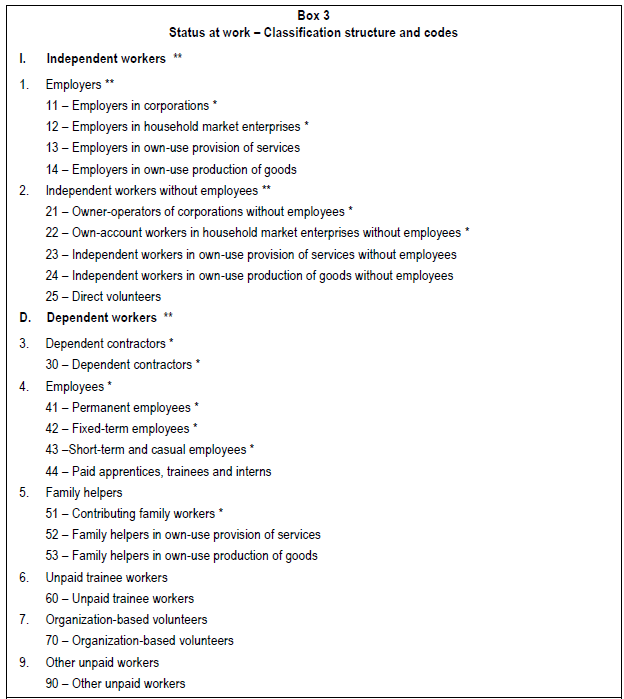
142. The structure of the Classification of Status at Work is shown in box 3, including names of categories and classification codes. Each detailed status at work category is assigned a two-digit code, in which the first digit represents the broad group and the first and second digits together represent the detailed category.
143. The categories marked with an asterisk ( *) are identical to categories included in the Classification of Status in Employment. Aggregate groups marked with two asterisks (**) also appear in the Classification of Status in Employment. Those marked with two asterisks have a broader scope in the Classification of Status at Work, as they include detailed categories that relate to forms of work other than employment. Detailed categories that appear in both ICSE-18 and ICSaW-18, are assigned the same two-digit numerical code in each classification.1
144. The section of the draft resolution that describes ICSaW-18 provides definitions of each of the categories that are not included in ICSE-18.
145. The 20 detailed categories in ICSaW-18 may also be aggregated according to the forms of work defined in the 19th ICLS resolution I when this is relevant for particular types of analysis or for the compilation of statistics on work relationships in the different forms of work. The draft resolution provides aggregates for workers in own-use production and volunteer work.
Status at work categories and the SNA production boundaries
146. The 2008 SNA provides a general definition of production followed by a more restricted definition that is used for the compilation of national accounts. The SNA therefore makes reference to the general production boundary and the production boundary in the SNA.
147. Economic production within the general production boundary is defined as any activity carried out under the control and responsibility of an institutional unit that uses inputs of labour, capital, and goods and services to produce outputs of goods and services.2 This concept of production is aligned with the 19th ICLS resolution I definition of work.
148. The production boundary in the SNA is more restricted in that it excludes activities undertaken by households that produce services for their own use. However, it includes services produced by employing paid domestic staff, and the own-account production of goods for own final consumption.3 The SNA also includes within the production boundary the activities of students who contribute some of their labour as an input to an enterprise’s production in return for education services4 (that is, unpaid apprentices, trainees and interns). It should be noted that this latter group of workers is explicitly excluded from employment by the 19th ICLS resolution I.
149. Concerning volunteers, the SNA notes that volunteers working for token amounts or with no remuneration within a recognized institutional unit, are still regarded as being employed in SNA terms. This is in contrast to the 19th ICLS resolution I which includes such workers in volunteer work. Those providing services without pay outside an institutional unit are not regarded as employed according to the SNA and their labour inputs are therefore beyond the production boundary in the SNA, but within the general production boundary.5
150. It may be concluded from all of this that, in addition to the status at work categories that refer to employment, all categories that refer to own-use production of goods, to unpaid trainee work or to volunteering through a recognized institutional unit relate to activities that are within the production boundary in the 2008 SNA, specifically:
14 – Employers in own-use production of goods.
24 – Independent workers in own-use production of goods without employees.
53 – Family helpers in own-use production of goods.
60 – Unpaid trainee workers.
70 – Organization-based volunteers.
151. The following detailed groups are concerned with own-use provision of services and with own-account volunteering (that is, not through any kind of organization) and are therefore beyond the SNA production boundary but within the general production boundary:
13 – Employers in own-use provision of services.
23 – Independent workers in own-use provision of services without employees.
25 – Direct volunteers.
52 – Family helpers in own-use provision of services.
Statistics about these activities may be presented as satellite accounts.
152. Since group 9 “other unpaid workers” may include various types of activity, it is not possible to say with certainty that these activities are within the production boundary in the SNA, although they would fall within the general production boundary as they must involve the production of goods or services for consumption by others. Since unpaid work ordered by judicial authorities would generally be organized through an establishment of some type, such as a prison or community service agency, it could be argued that conceptually this type of unpaid work would fall within the production boundary, even though it is unpaid and not voluntary. As these activities would rarely represent a statistically significant component of labour inputs to national production, it may not be necessary to produce estimates for these inputs, unless for a special descriptive or analytical purpose (for example, a study of the production of a particular good or service).
- ^ The Classification of Status at Work was in fact developed by taking the principles used to develop the draft ICSE-18, and applying them to all forms of work. Description of these classifications according to the Statistical Classification Model in the Generic Statistical Information Model (GSIM), however, requires ICSE-18 to be represented as both a derived classification based on ICSaW-18, and as a Statistical Classification Version in the Classification Series ICSE. The alternative ICSE-18 hierarchies may be represented as one or more variants of ICSE-18. See: https://statswiki.unece.org/display/gsim/Statistical+Classification+Model.
- ^ SNA, 2008, para. 6.24.
- ^ SNA, 2008, paras 6.26–6.27.
- ^ SNA, 2008, para. 19.21.
- ^ SNA, 2008, para. 19.39.